TA7784P is a dual pre amplifier IC used in mini audio cassette player, Radio and Car audio amplifier. In this article sharing Datasheet information’s including Pinout, Features and Characteristics.
Features of TA7784P Pre amplifier IC
- This ic is using in autoreverse type and w- cassette players.
- It has high voltage gain of 95db (an amplifier or system has increased the power of a signal by a factor of over 3 billion times).
- It has low number of input coupling capacitor if more capacitor means higher low-frequency cutoff point, meaning it will filter out more low-frequency signals and reduce low-frequency gain.
- Noise is very less, so the noise is same as the input signal have.
Characteristics of TA7784P
- Low distortion preamplifier IC
- Wide operating voltage range: 3V to 14V
- Low quiescent current consumption
- Built-in muting function
- High gain characteristics
- Low noise design for audio applications
- Designed primarily for car stereo and radio cassette applications
- Package: 16-pin DIP
TA7784P Pinout
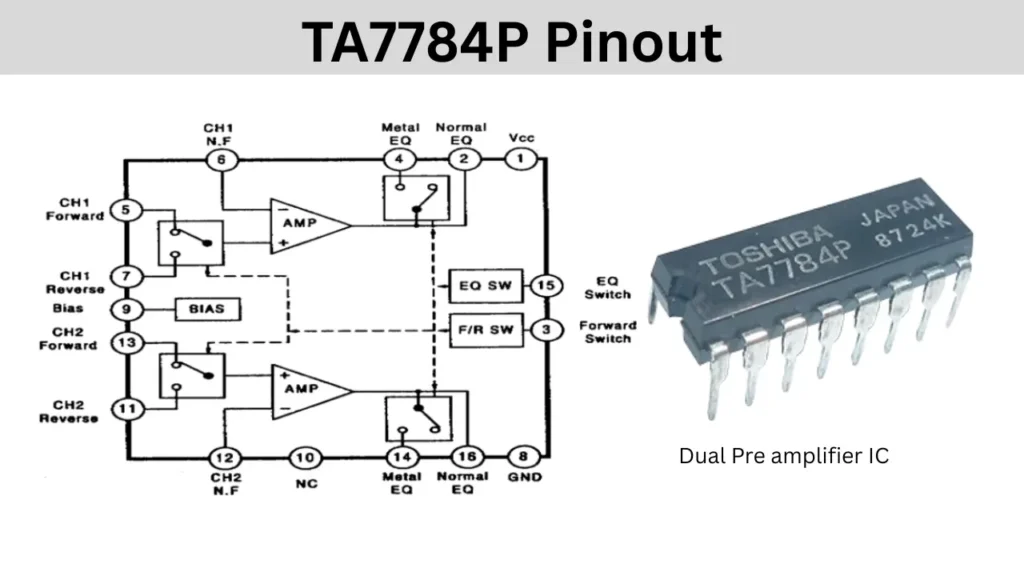
Channel Forward and Reverse Pins (CH1 and CH2)
The TA7784P audio preamplifier provides both forward (non-inverting) and reverse (inverting) signal paths for each channel. The forward path outputs the audio signal in its original phase, making it ideal when you want the output to remain exactly as the input without any phase change. This is typically used in standard preamp applications where maintaining the natural sound is important.
On the other hand, the reverse path inverts the signal by 180°, producing an output that is phase-flipped compared to the input. This feature is particularly useful in bridge tied load (BTL) configurations, phase correction, or when combining signals in audio systems to cancel out unwanted noise and interference. By offering both forward and reverse outputs, the TA7784P gives designers flexibility in handling different audio circuit requirements.
Normal EQ and Metal EQ
Cassette players use different equalization (EQ) settings depending on the type of tape being played, and the most common are Normal EQ and Metal EQ. Normal EQ, which uses a 120 µs time constant, is designed for standard ferric (Type I) tapes. Since these tapes have limited high-frequency response, the equalization boosts the treble range to make playback clearer and more balanced, while also keeping background noise under control.
Metal EQ, on the other hand, uses a 70 µs time constant and is intended for high-quality metal (Type IV) tapes. These tapes can handle higher frequencies with less distortion, so they require less treble boost. This EQ setting ensures the sound remains natural and detailed without becoming overly bright or harsh. Together, these EQ options allow cassette players to deliver the best possible sound quality for different tape formulations.
Applications
- Car stereo preamp.
- Cassette player.
- Radio tuner output stage.
- Low noise preamp for DIY audio projects.