What is Ohm's Law?
Ohms Law states that the current is passing through a conductor between two points is directly proportional to the voltage across the two points, and it inversely proportional to the Resistance value.
The Ohm's Law Formula
The equation to find out the Resistance using ohm's law is expressed as,
R = V÷I
- "V" is voltage.
- "R" is the resistance measured in ohms.
- "I" is the current in ampere.
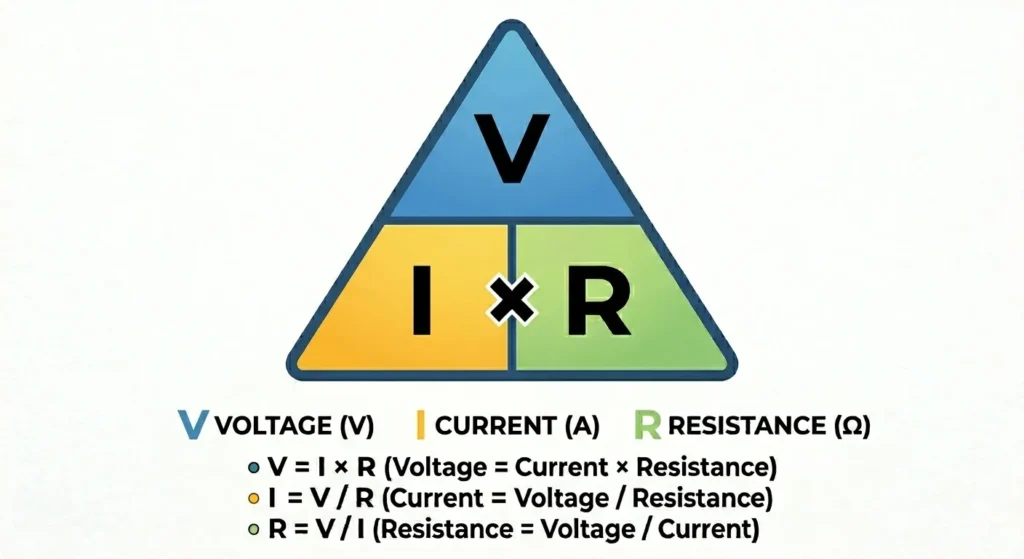
Ohm's Law formula triangle
Quick Reference Table
| To Find | Formula |
|---|---|
| Voltage (V) | V = I × R |
| Current (I) | I = V ÷ R |
| Resistance (R) | R = V ÷ I |
| Power (P) | P = I2 × R |
Example Calculation
- You have 9V battery and need to connect a 2V LED, its current is 0.02A (20mA). what resistor you need to safely light the LED?
Ans. using the ohms law we can calculated using the formula of
- A 12V car accessory has measured 4 ohms resistance. How many Amps will it draws?
Ans. I = 12V/4ohms = 3A
Related Electronics Calculator Tools