Need to find the equivalent resistance of a parallel circuit? Enter your resistor values into our fast, real-time calculator to get accurate results.
Parallel Resistor Calculation Formula
You can easily calculate the resistance of parallel-connected resistors using this online parallel resistor calculator. You can calculate the resistance of up to 10 resistors in parallel at a time. Find the correct resistor values and enter them into the parallel resistance calculator.
Calculate the Equivalent Resistance of Resistors Connected in Parallel
To calculate the equivalent resistance of resistors connected in parallel, enter the resistor values in the resistor R1 and resistor R2 input fields. If you connect a greater number of resistors in parallel, add an additional resistor slot for entering the value by pressing the add more resistors button in the calculator tool.
After entering the values of the resistors, select the appropriate unit for each resistor and click the “calculate” button to determine the equivalent resistance value for parallel resistors. You can calculate the parallel resistance of up to 10 connected resistors here.
For Two-Resistor Formula
What is Resistor
Resistors are tiny electronic components that are very familiar to most people, whether electronics hobbyists or not. People who are not interested in electronics also see resistors in many printed circuit boards. So I hope you know something about resistors, okay? Now, let’s go to the main topic: the parallel connection of a resistor. Why do you need a parallel connection? So before we talk about parallel connections, let’s share the basics.
The resistor is made with semi conductor material, which will resist the passage of current from one terminal to the other terminal. It has only two terminals. The resistance of the resistor is denoted by the color code on the resistor itself. The color of the ring on the resistor changes the resistance value. The high value means the highest resistance to the potential current. It is very difficult to pass through it.
Resistors in Parallel Connection
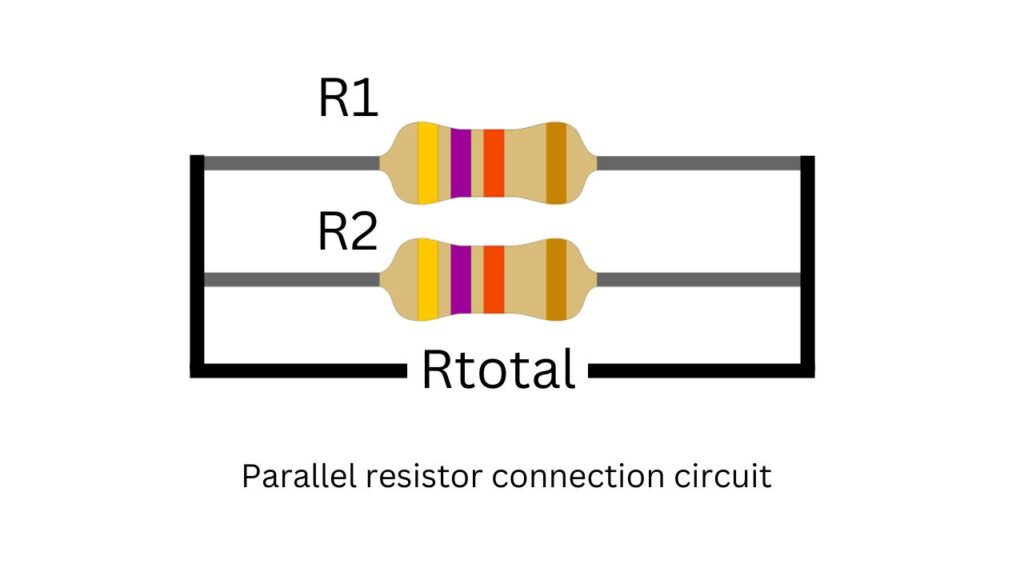
The resistor is in parallel connection means, that 2 or more resistors are connected to both ends at the same orientation or parallel to each terminal. To find whether the resistors are in parallel or series connection easily? If the resistors are connected end to end each other like train bogies, is known as a series connection. Now it is very clear to understand.
If you are connecting many resistors all connecting in parallel, the total resistance of the resistor will always be less than the smallest resistor value. As per the equation,
P =VI and The resistor in parallel has the same voltage across them at all times. But the changing factor is the current flow through it. Many resistors connect in parallel the tiny current flows through each of the transistors making a huge current reviving at the other end.
Example calculation
Example: You have a 10V battery and a 1K resistor. You put the resistor on a series connection with the battery poles, and by measuring the current flow, it shows 1mA. If you put a 10K resistor parallel to the 1K resistor, the current flow will not change across the battery and circuit. However, the 10 K resistor draws only 0.1mA across the battery. From the equation V =IR, it’s common for all electronic devices. The voltage, current, and resistance are also correlated with each other.
Resistor in Parallel Calculation Formula
The two resistors are connected in parallel R1 and R2, then the equation to calculate the parallel resistance of the resistor is,
1/Rtotal = 1/R1+1/R2
Solving the formula to obtain the formulas
Rtotal = ( R1*R2 )/(R1+R2)
To obtain the value of R1 then the formula
1/Rtotal = 1/R1+1/R2
Rtotal*R1*R2 {1/Rtotal = 1/R1+1/R2]
R1*R2 = Rtotal*R2+Rtotal*R1
R1*R2-Rtotal *R1 =Rtotal * R2
R1(R2-Rtotal) = R2*Rtotal
So, R1 = R2*Rtotal / (R2-Rtotal)
Where Parallel Resistors Are Used
- Voltage regulation
- Current sharing in power supplies
- Load balancing
- Speaker circuits
If you are having difficulty checking the resistor value, try using an online resistor color code Checker Tool.
FAQ
The parallel resistor circuit is consist of two or more resistors are connected in parallel. Each resistor’s terminals are connected to the same pair of nodes which providing a multiple paths for flow of current. In a parallel connection the voltage across each resistor is the same and the total resistance is always less than the smallest resistor in the parallel connection.
You can use this formula to calculate the resistance of parallel connected resistors is,
1/Rtotal = 1/R1 + 1/R2 +….1/Rn
If you enter invalid or non numeric values in the parallel resistor calculators input fields, the calculator will not perform the calculation and will prompt you to enter valid resistor values. Ensure that all input fields contain only numeric values.
In a parallel resistor circuit, adding more resistors provides additional paths for current to flow. As a result, the total resistance decreases because the current has more options to pass through. This will reducing the overall resistance of the circuit.