Calculating the resistor value for a single LED or a series of identical LEDs connected to a DC supply.
Overview
The LED has a forward voltage range and current. If you are planning to connect an LED to a DC supply, you need to limit the current for that LED to increase its lifespan. So, a correctly valued resistor is connected in series with the LED before applying the supply voltage. This method is not recommended for high-current LEDs because it needs more current to work.
How to Use This Calculator
There are three entry fields available in this calculator: supply voltage, LED voltage drop, and LED current. Enter the supply voltage you wish to connect to the LED. The LED voltage drop depends on the LED; a common chart for LED voltage drop is provided in the table below. Select the LED voltage drop based on the colour of the LED. After that, select the current that passes through the LED (normally 20 mA for an LED). After entering values in all fields, click the Calculate button to calculate the required resistance value.
A diagrammatic representation also shows the connection and the resistance value. When you click Calculate, the resistance value is also shown near the resistor symbol.
LED Series Resistor Formula
The series-connected resistor value changes when the voltage or current changes. So, in this series LED and resistor connection, the resistance value is calculated using the formula of,
- Where R is the resistance of the connected resistor.
- Vs is the supply voltage connected to the LED.
- Vled is the forward voltage of the LED. This will change based on the colour of the LED.
- Iled is the LED current.
- N is the number of LEDs connected in series.
Common Forward Voltage of LED Based on Color
| LED Color | Common Forward Voltage (Vf) | Typical Range (Vf) | Recommended Target Current (If) |
|---|---|---|---|
| 🔴 Red | 2.0 V | 1.8 V – 2.2 V | 15 mA – 20 mA |
| 🟠 Orange | 2.1 V | 2.0 V – 2.2 V | 15 mA – 20 mA |
| 🟡 Yellow | 2.2 V | 2.1 V – 2.4 V | 15 mA – 20 mA |
| 🟢 Green (Standard) | 2.2 V | 1.9 V – 2.5 V | 15 mA – 20 mA |
| 🟢 Green (True/Emerald) | 3.2 V | 3.0 V – 3.4 V | 20 mA |
| 🔵 Blue | 3.3 V | 3.0 V – 3.6 V | 20 mA |
| ⚪ White | 3.3 V | 3.0 V – 3.6 V | 20 mA |
| 🟣 UV / Violet | 3.5 V | 3.2 V – 3.8 V | 20 mA |
| 🕶️ Infrared (IR) | 1.2 V | 1.1 V – 1.5 V | 20 mA – 50 mA |
LED Series Resistor Connection Circuit
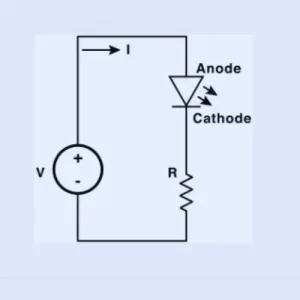
If you want to check all Resistor related calculations, you can go through the electronic engineering calculators which are combined with many other useful electronics tools for electronics hobbyist and engineering students to solve the problem.
Example Calculation
Case 1: You want to connect two Red LED to the display panel; the supply voltage is 9 V. You cannot connect the red LED directly; its safe operating current is 20 mA. What resistor do you need to use?
Solution
- Supply voltage is 9V DC.
- Red Led Forward voltage is (Vled): 2V
- Number of LED in Series (N): 2
- Led Current (Iled): 20mA
Step1: First we need to convert the current 20mA to A
Step 2: Calculate the Required Resistance
Using the series Resistor LED formula we can use.
In practical 250 ohms is not a standard value. So, you would grab the closest standard common value up of 270 ohms.