This is a tiny, simple car alarm blinking light (flasher) circuit built using a PC817 optocoupler. Few number of electronic components are used to build this project. This circuits flashing automatically with an interval of times. This article sharing the circuit diagram,. working and Applications.
What id Car Alarm Blinking Light Circuit
- When connected with 12V battery it starts to blinking the LED.
- Tiny LED blinking project.
- Noise is not initiating or altering the circuit function.
- The circuit is small and easy to understand its working.
Components Required
- PC817 – Optocoupler (isolates input and output, has an LED and a phototransistor inside)
- C1 – Electrolytic capacitor (470-1000 µF, 16 V)
- R1 – 1 kΩ resistor (for current limiting on the input LED of the optocoupler)
- R2 – 10 kΩ resistor (pull-up for the LED driver)
- LED – Indicator LED (simulating car alarm light)
- Power supply +12 V (car battery voltage)
Car Alarm Blinking Circuit Diagram
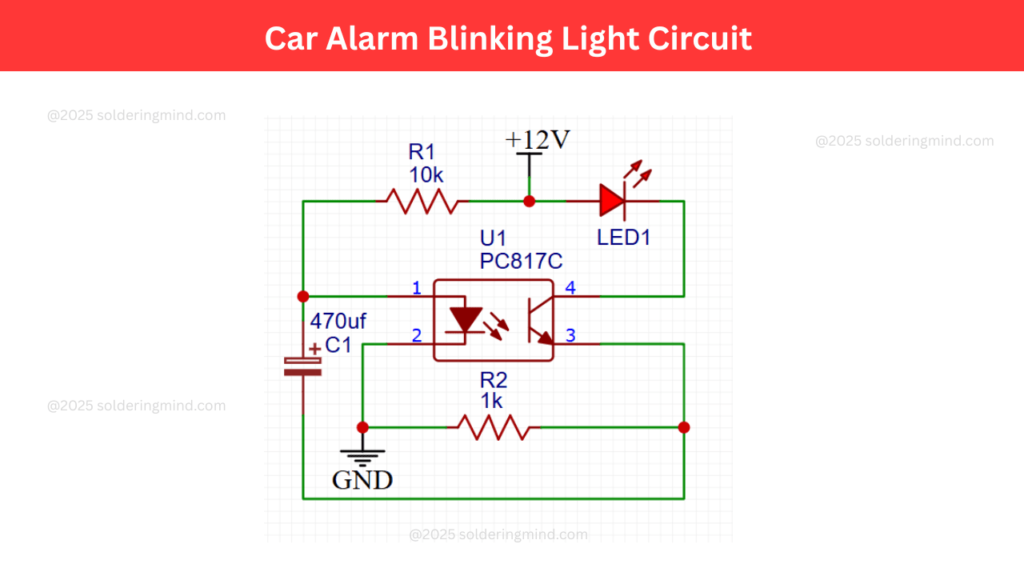
This simple car alarm blinking light circuit uses a PC817 optocoupler to create a flashing LED effect. This circuit project is powered by a 12V DC supply. The capacitor C1 (470µF) and resistor R2 (1kΩ) form a timing network that controls the charging and discharging cycle, when the capacitor is charged, the internal LED of the optocoupler ON and OFF. When the internal LED inside the PC817 lights up, the phototransistor conducts and it allowing the current to flow through the output LED (LED1), making it light up briefly.
As the capacitor charges and discharges through the resistors, the optocoupler’s LED toggles between ON and OFF states. This will causing the external LED to blink at a steady rate. The blinking speed depends on the capacitance of C1 and the resistance values of R1 and R2 a higher capacitance or resistance will slow down the blinking, while lower values make it flash faster. This circuit is often used as a fake car alarm indicator, giving the impression that a security system is active even when it’s just a low power LED flasher.
Working Principle
- When power is applied, the capacitor C1 charges through the 1 kΩ resistor.
- As the capacitor charges and discharges, it turns the internal LED of the PC817 ON and OFF.
- The phototransistor side of the PC817 switches the external LED accordingly.
- The LED connected to the output blinks, so it giving a flashing effect that mimics a car alarm indicator.
Application
- Simulated car alarm indicator light to deter theft.
- Basic LED flasher circuit demonstration.
- Simple example of optocoupler operation in switching applications.