To run DC motor forward and backward using a single 6 pin DPDT switch. This reverse polarity switch wiring will helps to control the rotation of motor in forward and backward. This connection is useful for Mini robots and RC cars. This article share its wiring diagram and working explanations.
Reverse Polarity Switch Wiring Connection Diagram
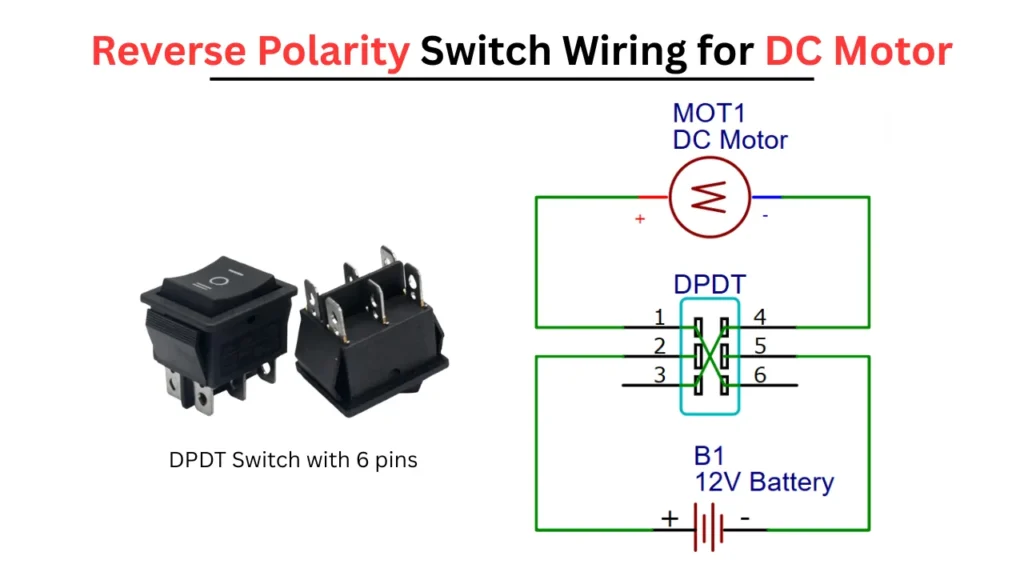
Reverse Polarity Switch Wiring
- Step 1: Identify terminals
- Step 2: Connect motor
- Step 3: Cross wiring
- Step 4: Connect power supply
What is a Reverse Polarity Switch?
The six pin DPDT switch is using as a reverse polarity switch by how the wiring is done on it. The connection diagram is given. The same way connect the battery and the DC motor connection to control motor in forward and backward by changing the polarity.
How a DC Motor Changes Direction
The DC motor changes its direction through changing the polarity given to the DC motor. When the positive terminal of DC motor connected to the negative and negative terminal of DC motor to the positive of the battery with reverse the rotation. This mechanism is happening in DPDT reverse polarity switch wiring.
Types of Switches Used for Polarity Reversal
- DPDT Switch.
- Toggle switch.
- Rocker switch.
- Relay based switching.
Working Principle of Reverse Polarity Switch
The DPDT switch has 6 pins. Three pins are arranged parallel to each other, Switch move to up or down the center pins and either one side pins are get connected. that means the center pin is using to connect the battery. The cross wiring is done with a small piece of wires.
Pin 1 connected to pin 6 and pin 4 connected to Pin 3. when the switch move forward the battery get contact with original polarity which meet with the Motor polarity and when push the switch down the polarity is changed. The motor rotates reverse.
Applications
- Robotics.
- Toy cars.
- Conveyor systems.
- Actuators.