BC108 Transistor is a metal can type transistor, this type is called as the Silicon planar epitaxial. The transistor is comes in TO-18 metal case packaging. In this article i’m sharing the information of pinout, characteristics and equivalent transistor numbers for replacement and common differences between other popular transistors.
What is a BC108 Transistor?
The transistor is a general purpose NPN transistor available in TO-18 Metal case packaging. Because of lower Noise generation this transistor is most common in audio amplifier circuits. The metal case packaging gives an efficient heat dissipation when it working on its full load.
BC108 Transistor Features
- Transistor Type: NPN, silicon planar epitaxial
- Package: TO-18 metal case
- Complementary PNP: BC177
- Collector-Base Voltage (VCBO): 30 V
- Collector-Emitter Voltage (VCEO): 20 V
- Emitter-Base Voltage (VEBO): 5 V
- Collector Current (IC): 100 mA
- Total Power Dissipation: 0.3 W (at 25°C)
- Junction Temperature (Tj max): 175°C
- Storage Temperature Range: -55°C to +175°C
- DC Current Gain (hFE): Typically 110 to 800 (varies by grade A/B/C)
BC108 Pinout
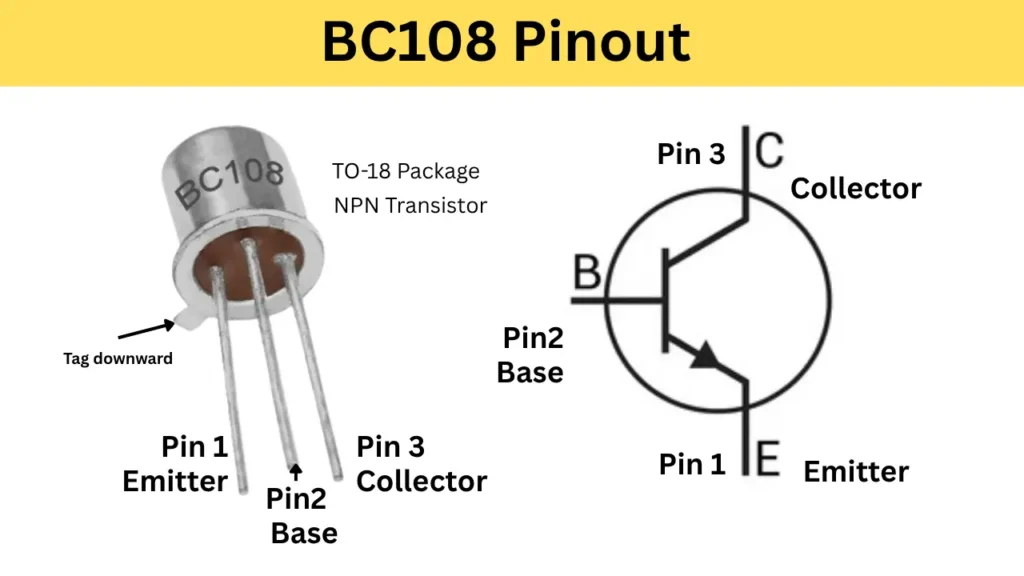
Placing the tag downward and count the pin number in clockwise direction. The position to count the pins are given in the image below, Pin 1 is Emitter, Pin 2 is Base and Pin 3 is collector.
| Pin Number | Pin Name |
|---|---|
| Pin 1 | Emitter |
| Pin 2 | Base |
| Pin 3 | Collector |
BC108 transistor equivalent numbers
You must check the pinout and characteristics of substitute transistors before replacing in the PCB or designing circuits.
- BC107 – Same family, higher voltage rating
- BC109 – Lower noise version, good for audio applications
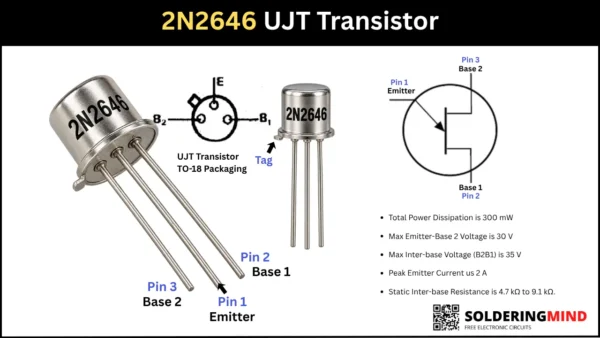
- 2N2222 – Similar NPN transistor, commonly used, higher current handling
- 2N3904 – General-purpose NPN, widely available
- S9014 – Common NPN transistor with similar specs
- KT315 – Russian equivalent with comparable characteristics
- PN2222A – American standard NPN similar to BC108
- BC548 – Plastic package version with similar electrical behavior
BC108 Transistor Applications
- Audio Preamplifiers.
- Signal Amplification.
- Switching Circuits.
- Oscillator Circuits.
- Pulse and Timer Circuits.
- Sensor Interface Circuits.
- TV and Radio Circuits
- LED Drivers – Used to switch LEDs on/off using microcontroller signals.
- Voltage Regulation Circuits – Works in feedback or control stages.
Difference between BC108 and BC109 Transistors
| Feature | BC108 | BC109 |
|---|---|---|
| Noise Level | Low | Very low (optimized for audio) |
| Purpose | General-purpose NPN | Low-noise audio applications |
| Gain Range (hFE) | 110 – 800 (varies by grade) | 200 – 800 (typically higher base gain) |
| Package | TO-18 metal can | TO-18 metal can |
| Maximum Collector Current (IC) | 100 mA | 100 mA |
| Max Collector-Emitter Voltage (VCEO) | 20 V | 20 V |
| Noise Figure | ~2–10 dB | ~1–4 dB (lower) |
| Equivalent Devices | BC107, BC109, 2N3904 | BC108, BC549C, 2N2222 (for low noise) |
| Application Focus | General amplification & switching | High-fidelity preamps, microphones |
Difference Between 2N3904 and BC108
| Feature | 2N3904 | BC108 |
|---|---|---|
| Transistor Type | NPN Silicon | NPN Silicon |
| Package | TO-92 (plastic) | TO-18 (metal can) |
| Maximum Collector Current (IC) | 200 mA | 100 mA |
| Collector-Emitter Voltage (VCEO) | 40 V | 20 V |
| Power Dissipation (Ptot) | 625 mW | 300 mW (up to 750 mW with heatsink) |
| DC Gain (hFE) | 100 – 300 | 110 – 800 (depends on grade A/B/C) |
| Transition Frequency (ft) | 250 MHz | ~150 MHz |
| Noise Figure | Medium (not optimized for low noise) | Low (better for audio use) |
| Cost & Availability | Cheaper, widely available | Slightly costlier, less common |
| Use Case | Switching, general amplification | Low-noise audio, signal amplification |