Are you looking for an alternative to the mechanical relay? control high voltage AC devices safely using low voltage DC input. This Solid State Relay circuit is the perfect solution for you. Their is no moving parts comparing with the mechanical relay or switches, it completely control the output voltage using electronic components.
Components Required
| Component | Value / Part Number | Quantity |
|---|---|---|
| R1 | 470Ω | 1 |
| R2 | 47Ω | 1 |
| R3 | 56Ω | 1 |
| R4 | 330Ω | 1 |
| R5 | 39Ω | 1 |
| C1 | 0.1µF | 1 |
| C2 | 0.1µF / 250V AC | 1 |
| Q1 | BT136 | 1 |
| Q2 | BC337 | 1 |
| U1 | MOC3021 | 1 |
| LED1 | Red LED | 1 |
| J1, J2 | – | 1 set |
| H1 | – | 1 set |
| H2 | – | 1 set |
Solid State Relay Circuit Diagram
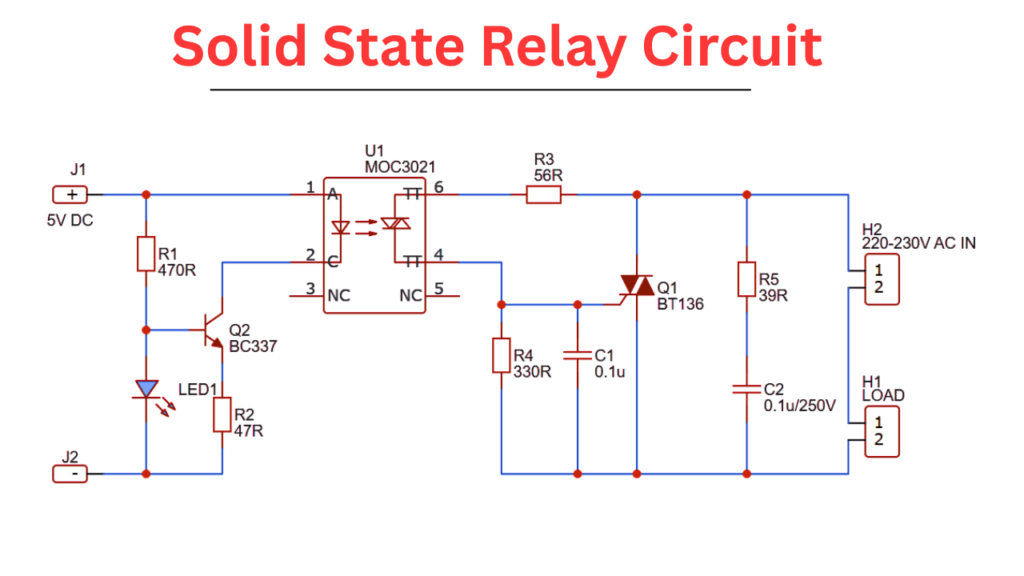
This circuit consist of MOC3021 opto-isolator and BT136 TRIAC. This circuit provides faster switching for 220 to 230V AC loads using a simple 5V DC control signal. This project is perfect for automation, home appliances and industrial controls. This solid state relay (SSR) design eliminates the mechanical wear and also ensures noise free, fast switching.
Construction and Working
This Solid State Relay circuit is built to on and off the high voltage AC loads using a low voltage DC signal. The circuit is powered with input Dc voltage of 5V connected to terminals J1 and J2. When the DC input is applied the current flows through resistor R1 and the LED1, which lights up to show that the circuit is active. This also turns on the BC337 NPN transistor (Q2) and it will allowing the current to flow through the internal LED of the MOC3021 opto-isolator.
Inside the MOC3021, the internal LED activates a photodiode and triggers the internal TRIAC, allowing AC triggering signals to pass through. The output side of the MOC3021 is connected to a BT136 TRIAC, which switches the AC load on or off depending on the signal. To providing the smooth operation and noise protection, a snubber network made of resistor R4 (330Ω) and capacitor C1 (0.1µF) is used across the TRIAC, while R5 and C2 help suppress voltage spikes.
Overall, this circuit works like an electronic switch. when you apply 5V DC, it safely and silently controls 220 to 230V AC devices like lamps, fans, or appliances without any mechanical parts.
Applications
- Home automation systems.
- Temperature control systems.
- Microcontroller based projects.
- Lighting control.
- Noise free switching.