As an electronics hobbyist and the founder of SolderingMind.com, I’ve worked on countless DIY automation projects and one of the most beginner friendly circuits I recommend is the LDR based automatic LED circuit. This simple light sensitive circuit uses a Light Dependent Resistor (LDR), BC547 transistor and a few resistors to control an LED based on ambient light conditions. When it gets dark, the LED automatically turns on, making it ideal for night lamps, garden lights or smart energy saving devices. In this guide, you’ll learn how the circuit works, how to build it, and why it’s a perfect first project for anyone exploring basic electronics.
Components List
| Component | Specification | Quantity | Description |
|---|---|---|---|
| Battery | 6V | 1 | Power source for the circuit |
| LDR (Light Dependent Resistor) | Standard LDR (10k–100k Ω in darkness) | 1 | Senses ambient light levels |
| Resistor | 1kΩ | 1 | Base resistor for transistor biasing |
| Resistor | 470Ω | 1 | Current limiting resistor for LED |
| Transistor | BC547 (NPN) | 1 | Acts as a switch based on LDR voltage |
| LED | White color | 1 | Lights up in the absence of light |
| Connecting wires | – | As required | For making circuit connections |
| Breadboard or PCB | – | 1 | Optional: Use breadboard for testing or PCB for permanent setup |
Circuit Diagram
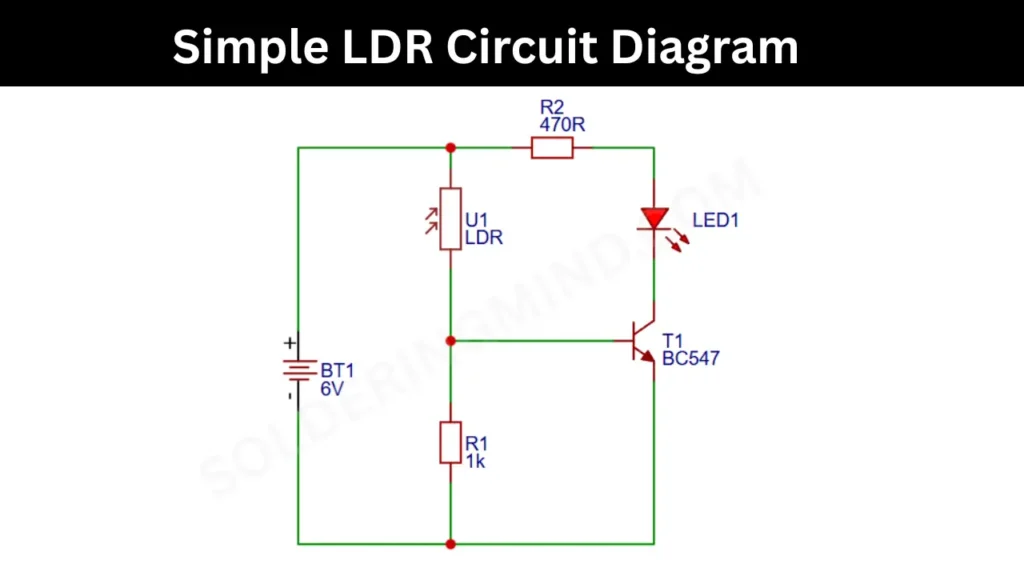
How the LDR Circuit Works
This circuit is designed to automatically turn on an LED in the absence of light. This is the basic concept for DIY night lamps, garden lights and smart lighting systems. Here’s explaining how it works, step by step.
Power Supply (6V Battery)
A standard 6V battery or adapter is using to powering the circuit. This will be using to give working voltage to voltage for the LDR, transistor, and LED.
LDR and 1K Resistor as a Light Sensing Voltage Divider
The LDR (Light Dependent Resistor) changes the resistance with light. A 1K resistor is connected with LDR and base voltage is takes from this voltage divider. In bright conditions the LDR’s resistance will drops and reducing voltage at the BC547 transistor base. In darkness resistance of LDR is rises and increasing the base voltage. This change in voltage is key to controlling the transistor on and off condition.
BC547 Transistor Acts as a Light Activated Switch
The BC547 NPN transistor serves as a automatic smart switch for controlling the light. When the base voltage increases the transistor turns ON, allowing current to pass from the collector to the emitter. This will glow the connected LED.
Application
- Automatic Street Lights
- Garden and Pathway Lighting
- Night Lamps for Homes
- Solar Lighting Systems
- School and College Projects