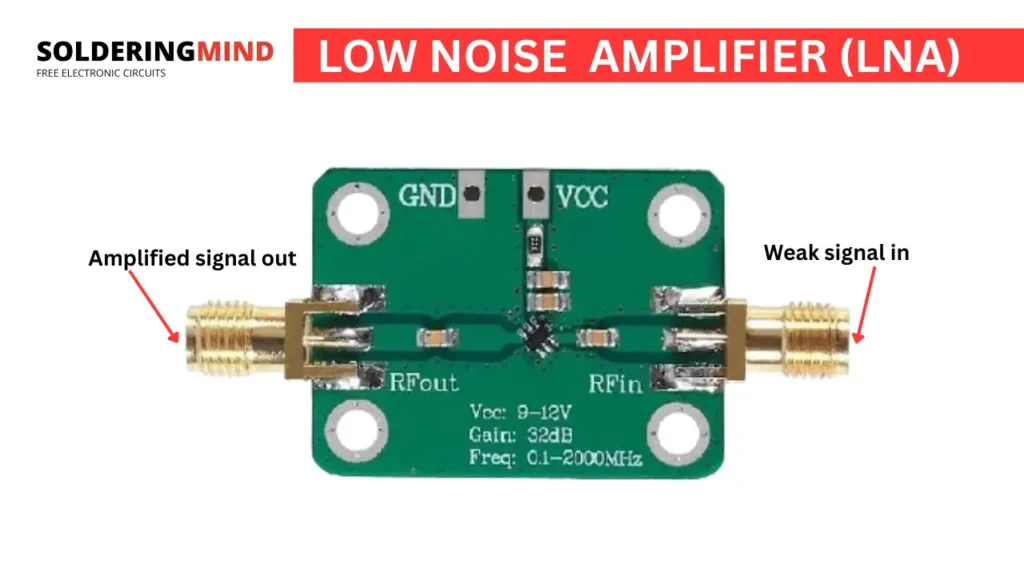
The Low Noise Amplifier is an electronic device that used to amplifying the weak signal without any degrading noise. The noise is commonly measured in signal noise ratio as SNR. This type of amplifiers are most common in first stage of signal receiver systems.
Low Noise Amplifier Definition
Amplifiers are the electronic device to boosting the input signal to high, that the same way The Low noise amplifiers are the electronic circuit which will amplifying the weak signal to high without noise, but actually it has very little noise. Its is placing close to the antenna to preserve the SNR ratio before further processing the signal.
Characteristics of Low Noise Amplifiers (LNA)
- It has a high gain and amplifying the weak signal for further signal processing.
- Very Low noise is added to the amplified signal and it is about 0.5–3 dB.
- Because of the linearity it prevent distortion and inter modulation in strong signal environments.
- In RF systems (like antennas, LNAs, cables, and receivers), most components are designed to have a characteristic impedance of 50 ohms (Ω).
- Impedance matching means making sure the input impedance of the LNA equals the source (antenna/cable) impedance, and its output impedance equals the load (next stage) impedance.
Applications
- In RF & Microwave Receivers the LNA is used in communication systems (cellular, Wi-Fi, GPS, satellite, radar).
- Medical Devices Like MRI, ultrasound, and biomedical sensors where weak signals need clean amplification.
- In Radio Astronomy LNA is used to Detects extremely weak cosmic signals.
- Instrumentation, the Low noise amplifiers are used in Low-level sensor signal amplification.