Still you are Pressing manual button for turn ON or OFF your electronic or electrical devices. The TTP223 Touch sensors module can replace the mechanical buttons in many modern electronic devices. One of the most popular and affordable choices for DIY electronics is the TTP223 capacitive touch sensor module. This tiny 6 pin IC based touch detector board can able to convert any surface into a touch responsive input.
In this article, we will explore the working principle, pinout, features and circuit diagram of the TTP223 touch sensor.
Also Check : TTP223 Touch Sensor ON/OFF Circuit
TTP223 Touch Key Switch Module Touching Button Capacitive Switches Self-Locking/No-Locking Jog 2.5-5.5V (20)
- Supports momentary or latching/toggle modes, response time max: 60mS in fast mode, ~220mS at low power mode @VDD=3V, Touch-based responsive control without physical buttons.
As an Amazon Associate, I earn from qualifying purchases.
Features of TTP223
- Operating Voltage: 2.0V-5.5V.
- Ultra-low operating current of approx. 1.5 µA in low power mode and 3.5 µA in fast mode.
- Fast Response Time of 60ms in fast mode.
- Sensitivity adjustable using external capacitor (0-50pF).
- 220ms in low power mode.
- Auto calibration every 4 seconds when untouched.
- Direct & Toggle output modes.
- Active high or active low output selection.
- Supports maximum ON time limit of 100 seconds.
- Stable detection through plastic, glass, acrylic panels.
TTP223 Touch Sensor Circuit Diagram
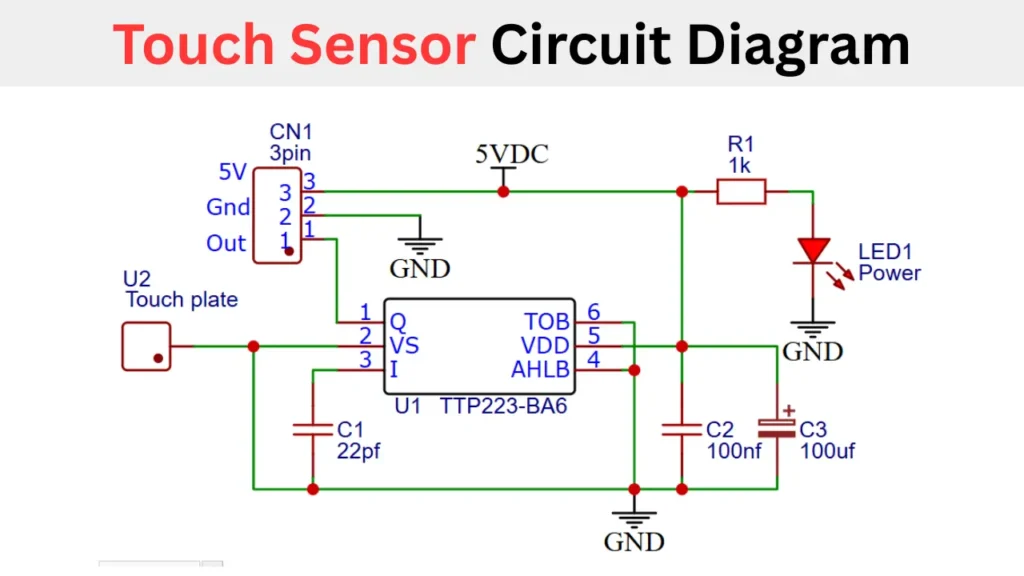
The TTP223 is a single key touch pad detection IC and it is designed to replacing the traditional mechanical buttons like push buttons. It detects changes in capacitance value when a human finger touches the pad and this will produces a clean digital output. The IC supports multiple modes such as direct mode, toggle mode, active high or active low output modes.
Working Principle
The working principle of the TTP223 touch sensor is based on capacitive sensing, where the IC continuously monitors the capacitance of the touch pad connected to its input pin.
When a human finger approaches or touches the pad, the capacitance value increases due to the body’s natural electrical properties. This will causing the sensor oscillator inside the IC to detect a significant change compared to its calibrated reference level.
This will triggers the output pin to switch HIGH or LOW depending on the configured mode. The IC is auto calibrates periodically and ensuring a stable and accurate touch detection even through non metallic surfaces like plastic, acrylic, or glass.
Applications
- Touch-based ON/OFF switches
- Home appliances
- Water-proof user interfaces
- Control panels
- Toys and gadgets
- LED touch lamps
- Embedded and Arduino projects