Actually a Transistor based circuit gives 12V or 15V DC to the Class d amplifier IC? No that’s not a positive voltage, but why it is working? Lot of questions now arise. Lets discuss in this article. get better understanding about the Class d amplifier bias voltage.
Circuit Function Overview
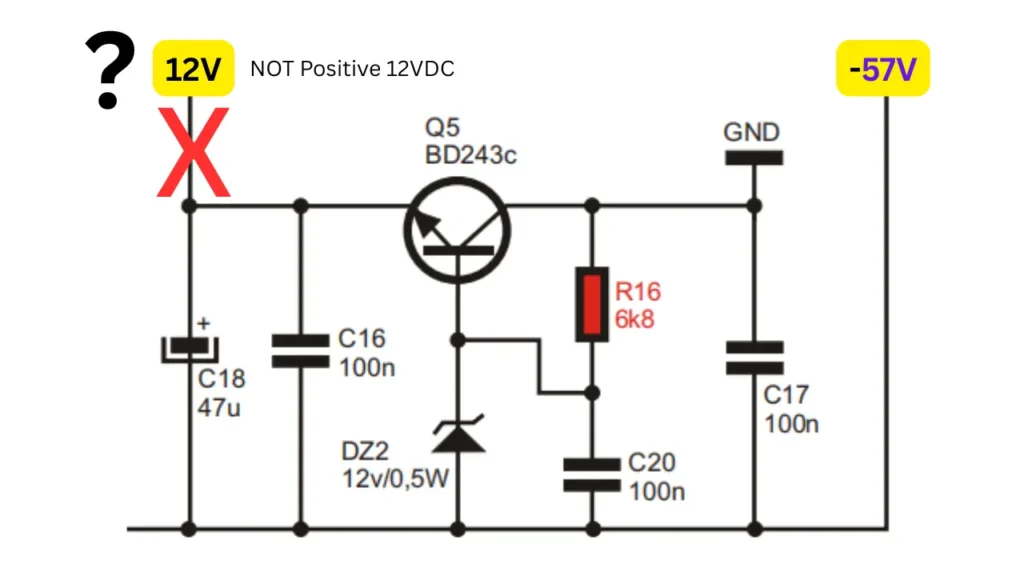
The section shown in your diagram uses an NPN transistor (BD243C) and a Zener diode (DZ2) to regulate part of the negative supply rail. The circuit’s main supply is –57V, and through the Zener diode, a stable reference voltage is created for biasing. The Zener diode, rated at 12V, keeps the transistor’s base about 12V higher (less negative) than the –57V line, resulting in the transistor’s emitter being around –44V with respect to ground.
Understanding the Output Voltage
Although the emitter of the BD243C is more positive than –57V, it is still negative with respect to ground. This means that even though it appears “positive” compared to the –57V rail, it is actually a regulated negative voltage output (approximately –44V). Such a voltage is typically used within the amplifier circuit to power or bias certain internal negative supply stages.
In short:
Relative to ground → –44V (negative)
Relative to –57V → +12V (less negative)
Why You Can’t Run a 12V DC Fan Directly
A 12V DC fan requires a +12V supply relative to ground, not a negative one. Connecting it directly to this node (–44V) would reverse the polarity and supply nearly 44V in the wrong direction, which would immediately damage the fan. This regulator stage was designed for low current biasing, not for powering external loads like fans.
Safe Ways to Power a 12V Fan
Use a Separate 12V Supply: The safest and simplest solution is to use a small 12V DC adapter or a regulated power source dedicated to the fan.
Use a DC–DC Converter: If your amplifier’s main supply is ±57V or –57V only, you can use a DC–DC buck converter that steps down the high voltage to +12V. Modules such as “48V to 12V DC converters” are commonly available and can safely power a fan.
Avoid Drawing from Bias Circuits: The transistor and Zener network you see in the schematic are meant for precise internal voltage control, not for powering external devices. Drawing extra current from them can upset amplifier biasing and lead to instability or damage.
Summary
The BD243C Zener circuit generates a regulated negative voltage (–44V) derived from the –57V rail, not a positive 12V output. A 12V DC fan cannot run from this point because it requires a +12V supply relative to ground. To power your fan safely, use a separate +12V supply or a DC DC converter designed for high-voltage input.