To determine whether the lead acid battery is good or Bad, we need to evaluate the battery voltage, performance under the load, and the battery’s physical appearance. A good battery will maintain a stable charge and backup time with low sulfation in it. So this guide will helps you to check the main things before considering whether the battery is good or bad.
What Causes a Lead Acid Battery to Go Bad?
- Sulfation inside the battery plates.
- Overcharging or Undercharging.
- Excessive stress to battery by high load discgharging.
- Corrosion of battery plates.
- Operating temperature and Age.
How to Check if Lead Acid Battery is Good
Resting Voltage Test Using Multimeter
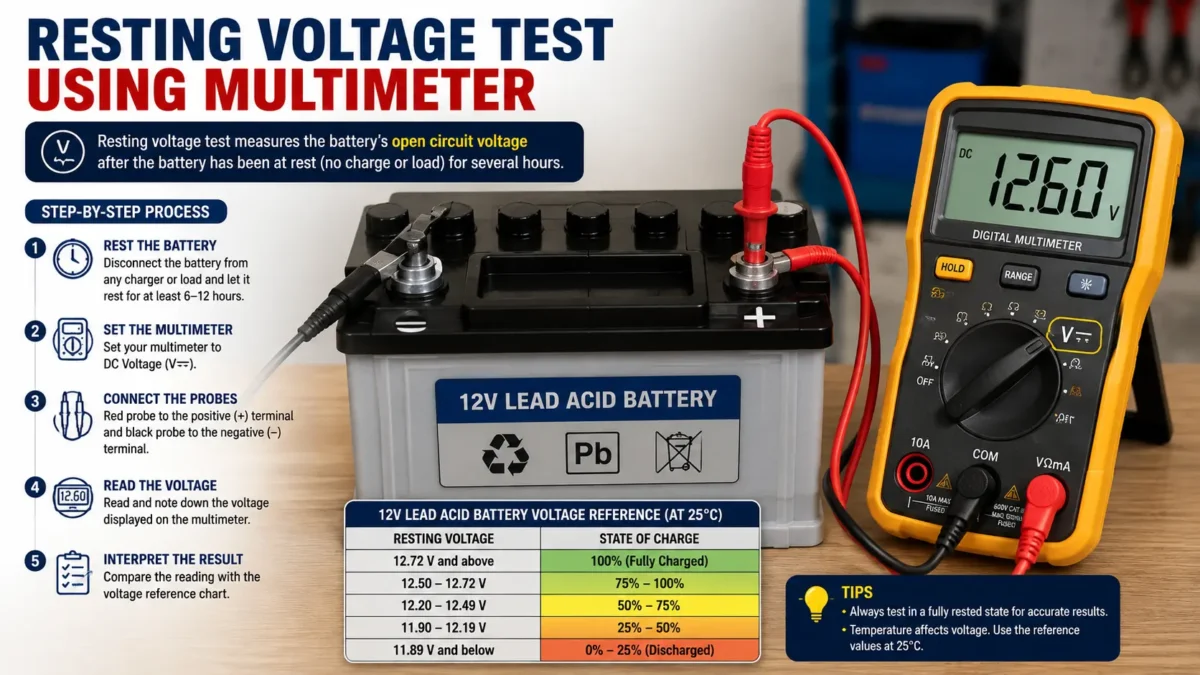
Place the battery for 3 or 4 hours and do not connect the charger or any devices. Then connect the multimeter and check the voltage across the positive and negative terminals.
✔ A good battery shows a voltage of between 12.6 to 12.8V in good, healthy condition in a full charge state. If the voltage is below 12.2V it means it is sulfated heavily and not a good battery to choose.
Under Load Testing of Battery
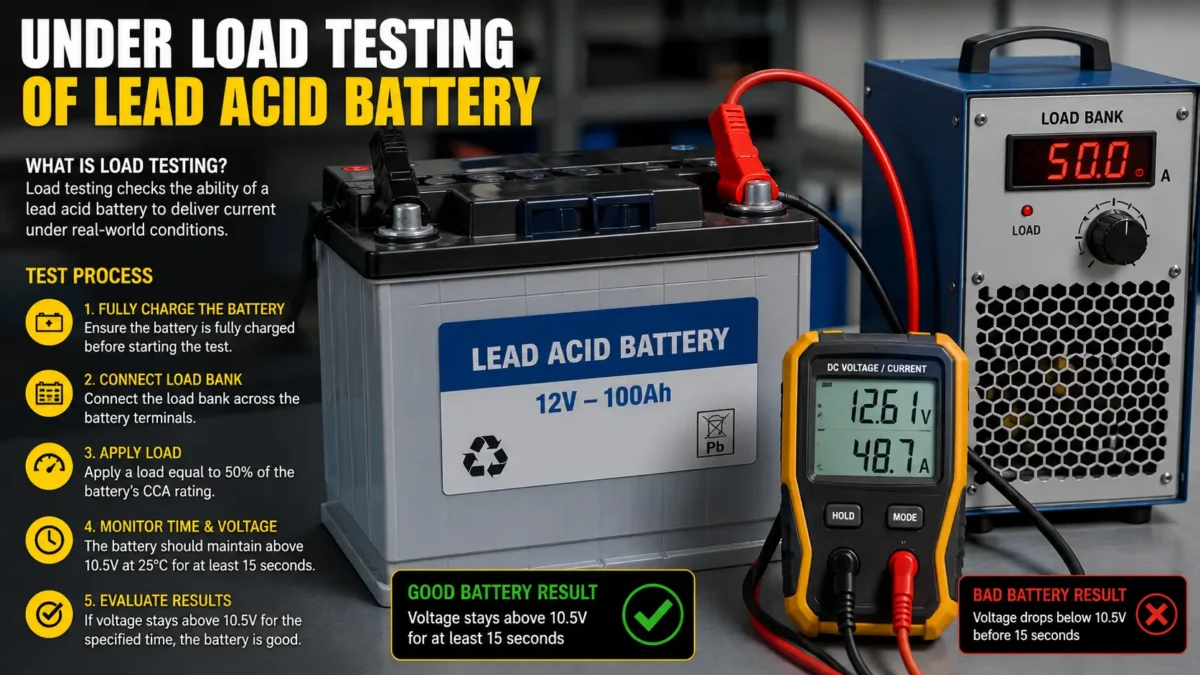
If your battery shows good reading in multimeter and which is not the final decision making thinks. You need to connect the battery to the high current drawing device such as starting Motor of car or any other load tester device to check the voltage when load is active.
✔ A good battery remains stable at 9.6V to 10.5V during cranking. If the voltage goes below the 9.5V means the battery is dead of bad condition.
Physical or Chemical Inspection
The battery can sometimes be easily identified as good or Bad by looking at its physical appearance and gravity checking. During inspections, look for battery bulging or cracks; if they persist, the condition of the battery is not good.
Use a hydrometer to test the battery gravity of sulphuric acid in each cell. A healthy, fully charged lead acid battery has a gravity reading between 1.265 to 1.280 at 25° C. The value between 0.03 to 0.05 means the battery is defective and in bad condition.