The TA8215H is a Stereo audio amplifier IC give 18 Watt per channel. It is also available in TA8215L both are the same IC give powerful audio output. Its operating DC supply voltage is 18V DC, so it is a perfect choice for Home and car audio systems. This article shares the circuit diagram, components list and additional information’s regarding TA8215H amplifier Circuit.
TA8215H Amplifier Circuit Diagram
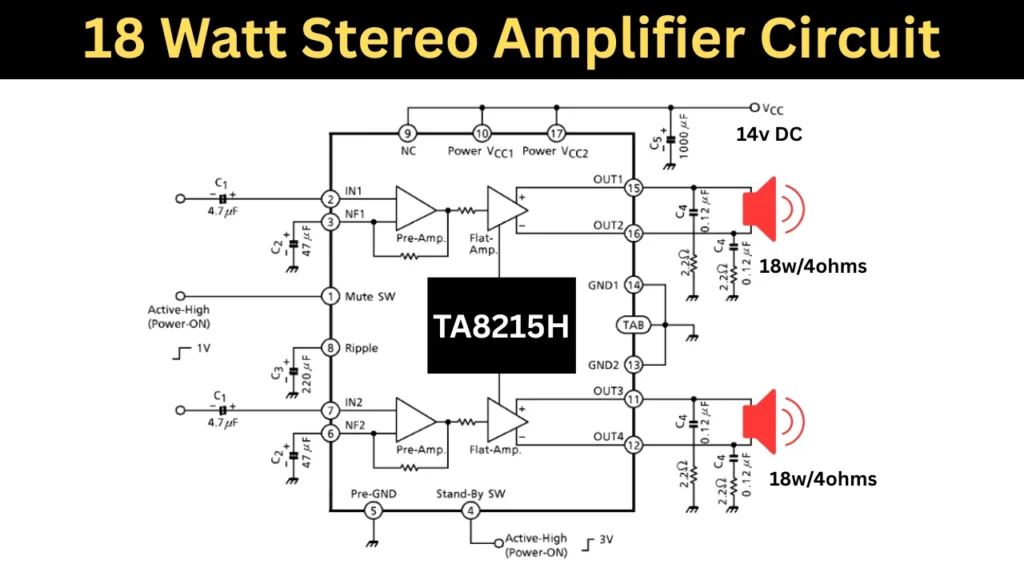
The input voltage is 14V DC regulated power supply. This audio amplifier gives 18 watt output power at 4 ohms speaker. If you are giving the DC voltage about 12 to 13V the amplifier output will be 15 Watt on each speakers.
Components Required
| Component | Value | Quantity | Description |
|---|---|---|---|
| IC | TA8215H | 1 | Dual channel audio amplifier IC |
| C1 | 4.7µF / 25V | 2 | Input coupling capacitor |
| C2 | 47µF / 25V | 2 | Feedback capacitor |
| C3 | 220µF / 25V | 1 | Ripple filter capacitor |
| C4 | 0.1µF (100nF) | 4 | Output stability capacitor |
| C5 | 1000µF / 25V | 1 | Power supply filter capacitor |
| Resistor | 2.2Ω | 4 | Output Zobel network resistor |
| Speaker | 4Ω, 18W | 2 | Audio output speakers |
| Power Supply | 14V DC | 1 | DC power source |
| Switch | SPST | 2 | Mute and Standby control switches |
| Heat Sink | Suitable size | 1 | Required for IC cooling |
Connection Explained
The audio input pins of pin number 2 and pin number 7 is connected with a 4.7uf/25v electrolytic capacitor, which is input coupling capacitor and separates the input device with audio amplifier circuit and allows the audio signal passing through it.
Pin number 9, 10 and 17 are connected to the positive supply rail, where the 11 and 17 is the VCC connection of the IC. Pin number 5, 13, 14 and tabs are connected to the ground supply of the circuit.
The speakers are connected in 15 and 16 number of pin and the other one connected in pin number 11 and 12. You can control the standby of the amplifier by applying the 3v to the pin number 4 of the IC.
Applications
- Home audio systems.
- Desktop or PC speaker systems.
- Portable speaker projects.
- Car audio amplifier systems.
- DIY audio amplifier kits.
- Small PA (Public Address) systems.
- Bluetooth speaker systems.
- Multimedia speaker setups.
- Radio and FM receiver audio output stage.
- Educational electronics projects and demonstrations.