In past years the amplifiers were built with vacuum tubes. In that time which are very popular and
Most people are buying heavy vacuum tube based power amplifiers for their needs. Introduction of new electronic components like Transistors, MOSFET and IC changes all the things. This leads to the new solid state amplifiers to the market.
Introduction to Solid State Power Amplifier
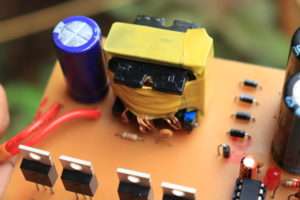
The solid state power amplifier is an electronic amplifier mainly built with semiconductor components like transistors, MOSFETS or IC. This replaces the OLD vacuum tubes and increases the power level of the amplifiers.
These amplifiers are widely used in home and car audio systems, communication equipment, industrial electronics and broadcasting due to their high efficiency, compact size and long life.
What is a Power Amplifier?
A power amplifier is the device that boosts the input signals to high amplitude signals to drive large wattage speakers. The input signal is weak and it can not move the speaker coil, so the loud sound is not possible.
Working Principle of Solid State Power Amplifier
The working principle of a solid state power amplifier is based on controlling a large output current using a small input signal. The input signal is first processed by pre amplifier circuits and driver stages. Then it is fed into the output stage where the power transistors or MOSFETs will amplify the input signal. These devices operate in different classes and the classes are depending on the design, balancing efficiency and distortion. The classes are listed below,
Main Components of Solid State Power Amplifier
A typical solid state power amplifier consists of several key components, which are listed below
- Input Stage, which receives and conditions the low level input signal.
- Driver Stage, it provides a sufficient current to drive the output transistors.
- Output Stage, In this stage uses high power transistors or MOSFETs to deliver power to the load.
- The Power Supply section supplies the required DC voltage and current.
- Feedback Network will improve stability, gain control and reduce the distortion.
- The Protection Circuits protect the device from short circuits, overheating and overcurrent.
Types of Major Solid State Power Amplifier
| Class A | Class B | Class AB | Class D |
|---|---|---|---|
| Conducts for the entire 360° of the input signal cycle | Conducts for 180° of the input signal cycle | Conducts for more than 180° but less than 360° | Operates in switching mode using PWM |
| Very low distortion and high audio quality | Higher efficiency than Class A (up to ~70%) | Combines good efficiency with low distortion | Very high efficiency (up to 90–95%) |
| Poor efficiency (around 25 to 30%) | Suffers from crossover distortion | Most widely used in audio power amplifiers | Minimal heat generation |
| Generates a lot of heat | Common in push pull configurations | Balanced performance and sound quality | Widely used in modern digital audio systems |
Advantages of Solid State Power Amplifier
- High efficiency compared to tube amplifiers.
- lightweight design and setup compared with other.
- Low maintenance and long life compared with vacuum tubes.
- Better thermal stability.
- Lower power consumption.
- Cost effective for mass production.
Disadvantages of Solid State Power Amplifier
- Can introduce higher distortion if poorly designed.
- Less “warm” sound compared to tube amplifiers (subjective).
- Sensitive to voltage spikes and overheating.
- Repair can be difficult at component level.
Solid State vs Tube Power Amplifier
When compared with solid state amplifiers and tube amplifiers, solid state amplifiers are more efficient and low cost. But the tube amplifiers are preferred for high quality audio sounds. The solid state amplifiers dominate in modern electronics due to their practicality and performance.