The BC161 is a general purpose PNP silicon transistor comes in a TO-39 metal packaging case. This transistor is specifically designed for low-frequency power amplification and switching applications. It can handle the collector currents of up to 1A and voltages up to 60V, so thuis will makes this transistor is suitable for use in audio amplifiers and amp driver stages. In this article i’m sharing the Pinout, characteristics and equivalent transistor numbers for replacement.
What is BC161 Transistor
The BC161 is a PNP transistor and it is available in TO-39 Metal case of packaging. The structure make it more efficient in heat management. This transistor is acts like an electronic switch or amplifier. It can allows a small current at the base pin and this time it control a larger current between the collector and emitter pins. So this makes it useful in circuits like audio amplifiers or on/off control switching circuits.
Transistor is Manufactured with planar epitaxial technology, the BC161 delivers reliable performance with a wide range of current gain (hFE) and it has a complementary NPN Transistor of BC141. This transistor is commonly used in both hobby electronics and professional circuits due to its robust characteristics and versatility.
BC161 Transistor Pinout
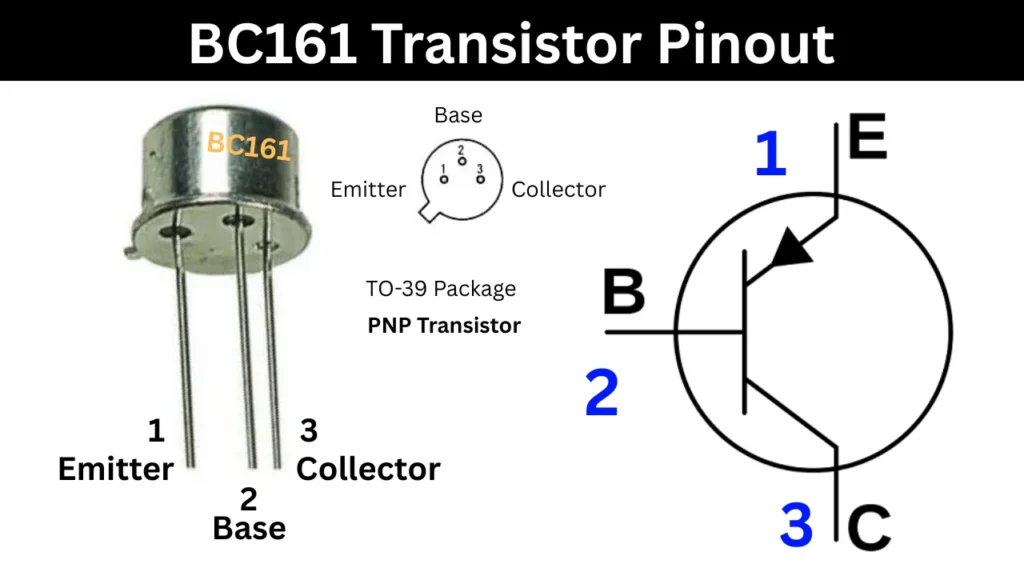
- Pin 1: Emitter (E)
- Pin 2: Base (B)
- Pin 3: Collector (C)
Characteristics of BC161
- Type: PNP silicon transistor
- Package: TO-39 metal can
- Maximum Collector Current (IC): 1A
- Collector-Emitter Voltage (VCEO): -60V
- Emitter-Base Voltage (VEBO): -5V
- Collector Power Dissipation: 0.65W (ambient)
- DC Current Gain (hFE): 40 to 250 (depending on group and test current)
- Transition Frequency (fT): 50 MHz
- Low Collector-Emitter Saturation Voltage: as low as -0.1V
- Operating Junction Temperature: up to 175°C
- Complementary Pair: BC141 (NPN)
Thermal and Power Handling Capabilities
The BC161 transistor is designed to handle moderate power levels, making it suitable for audio amplifiers and switching applications. It can safely dissipate up to 3.7 watts of power when mounted on a proper heatsink (measured at the case), and up to 0.65 watts in open-air conditions (measured at ambient temperature). The transistor can operate at high temperatures, with a maximum junction temperature of 175°C, and a storage temperature range from –55°C to +175°C.
To maintain performance and prevent thermal damage, proper heat dissipation methods such as attaching a small heatsink to the metal TO-39 case or ensuring good airflow are recommended. The thermal resistance is also important: it has a junction-to-case thermal resistance of 35°C/W and a junction-to-ambient resistance of 200°C/W, which affects how quickly the transistor heats up during operation.
Equivalent Transistor for Replacement
The suitable equivalent transistors are given below, you must recheck with its pinout configuration before placing in to the PCB.
- BD136 – PNP, similar current and voltage handling, plastic TO-126 package
- 2N2907 – General-purpose PNP transistor, widely available
- BC328 – PNP, similar current gain and switching characteristics
- TIP32 – Higher power PNP transistor (can replace BC161 in higher power circuits with proper biasing)
- BC559 – For low power applications with similar characteristics
- BC556 / BC557 – Lower current versions, usable in signal-level circuits
BC161 and BC141 Complementary Pairs
The BC161 and BC141 transistors are complementary pair of transistors, which means they are designed to work together in electronic circuits especially in amplifier designs like push pull audio stages. The main difference between them is their polarity. The BC161 is a PNP transistor and the BC141 is an NPN transistor. This means the BC161 turns on when the base is more negative than the emitter.
The BC141 transistor will turns on when the base is more positive. Both come in the same TO-39 metal package and can it can handle similar voltage and current of up to 60V and 1A. They also have similar gain (hFE) and frequency response, making them suitable for audio amplification and switching tasks. In simple terms, you can think of them as a matched pair that behave oppositely, which is useful for building circuits that need both types of signal flow.
Safe Operating Conditions for BC161
To ensure long term working and prevent damage of component, the BC161 transistor should be used within its specified safe operating limits. It can handle the collector-emitter voltage of up to –60V, a collector-base voltage of –60V, and an emitter-base voltage of –5V. The maximum collector current should not be exceed 1A, and the base current must be kept below 0.1A.
When the operating in ambient temperatures, power dissipation should be limited to 0.65W, or up to 3.7W with proper heat sink. The transistor should also not be exposed to temperatures beyond –55°C to +175°C, as higher temperatures may degrade performance or cause failure. Staying within these limits will helps to ensure that the transistor is works safely in audio, switching and general purpose applications without any overheating or electrical breakdown.
Application
- Used in audio amplifiers to boost sound signals
- Works with BC141 in push-pull amplifier circuits
- Acts as a switch to turn devices on or off
- Helps control motors or relays in circuits
- Used in voltage regulator circuits
- Can dim LEDs or control light brightness
- Used in signal amplifiers to boost weak signals
- Suitable for DIY and hobby electronics projects