The 2N4403 is a widely used PNP transistor (BJT) and it is designed for general purpose applications like low power switching and amplification. its has moderate gain, relatively high collector current capability and good frequency response, so it is commonly used in signal processing, audio stages and small driver circuits. This article describes pinout, specifications and equivalent transistor for replacement.
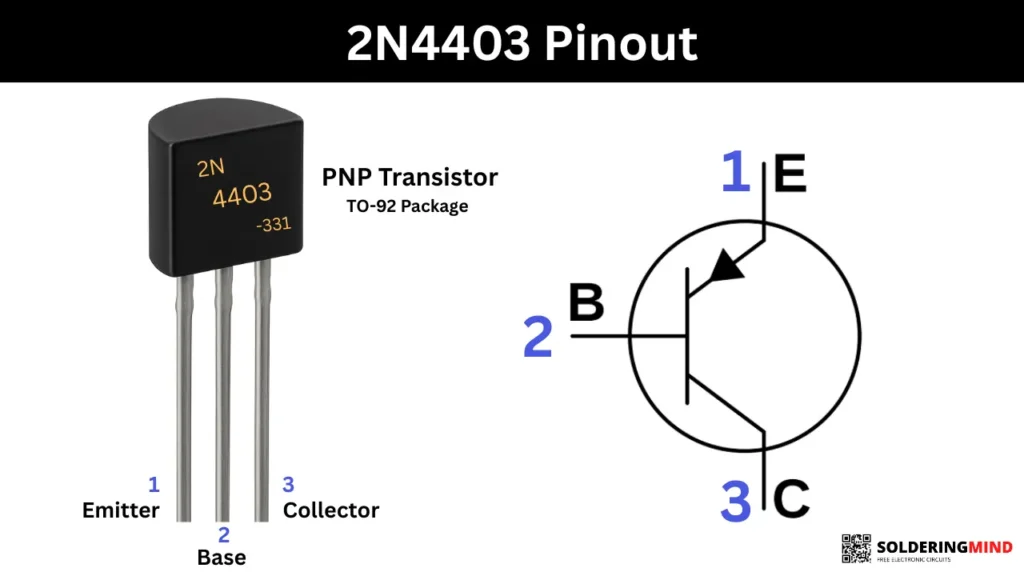
2N4403 Transistor Pinout
The 2N4403 comes in a TO-92 package. Looking at the flat side of the transistor with leads pointing down, the pinout is:
- Emitter
- Base
- Collector
2N4403 Features
- PNP Silicon BJT
- Maximum continuous collector current: 600 mA
- Low saturation voltages.
- Moderate DC current gain (hFE) up to 300 depending on operating current.
- High transition frequency (fT = 200 MHz) for small-signal applications
- Available in Pb-Free (RoHS) versions
Transistor Maximum Ratings
- Collector-Emitter Voltage VCEO: 40 V
- Collector-Base Voltage VCBO: 40 V
- Emitter-Base Voltage VEBO: 5 Vdc
- Collector Current (continuous) IC: 600 mA
- Total Power Dissipation @ 25°C (TA) PD: 625 mW
Equivalent Transistor for Replacement
The 2N3906 transistor has lower current about 200 mA but it has the similar characteristics with the 2N4403. The 2SA1015 transistor has higher gain and widely used in audio.
BC557 / BC558 / BC559 series of transistors are most common and easy to available (European equivalents). The transistor PN2907 has similar to 2N3906 but it have higher current.
If you are looking for Higher Power Alternatives, you can use BD140 it can handle higher currents. always check the pinout configuration when you are replacing the transistors.
2N4403 vs 2N3906
| Feature | 2N4403 | 2N3906 |
|---|---|---|
| Polarity | PNP | PNP |
| Collector current (IC max) | 600 mA | 200 mA |
| Current gain (hFE) | Up to 300 | Up to 300 |
| Transition frequency (fT) | 200 MHz | 250 MHz |
Complementary Transistor
The complementary transistor of the 2N4403 PNP device is the 2N4401 NPN, designed with closely matched voltage, current, and gain characteristics, making the pair ideal for creating symmetrical circuits such as push-pull amplifiers, Class-AB audio stages, and general-purpose driver or switching configurations. Their similar electrical behavior and shared TO-92 package allow designers to easily use them together when opposite-polarity transistors with balanced performance are required.
Applications
- Low power switching circuits.
- Signal amplification.
- Audio pre amplifier stages.
- Sensor interface circuits.
- Low current driver stages.
- General-purpose analog circuits.