The LF353 is a dual operational amplifier IC that uses Junction Field-Effect Transistor as inputs. This IC is providing a high input impedance, Low input bias current, Low noise, Fast response and uses very Low power for working. This article contains the information’s about pinout configuration, Equivalent number of IC for replacement and comparison with popular op amp Ic’s of 4558 and TL072.
Features and Why They Matters
| Feature | What It Means | Why It’s Important |
|---|---|---|
| Low Input Bias Current (50 pA typical) | Very small current flows into the input pins. | Ideal for high-impedance sensors and circuits. Prevents signal distortion. |
| Low Input Noise Current (0.01 pA/√Hz) | Very little electrical noise added by the op-amp. | Useful in audio and precision analog circuits for clean signals. |
| Low Supply Current (3.6 mA typical) | It draws very little power from the power source. | Helps save power in battery-operated or low-power systems. |
| High Input Impedance (10¹² Ω typical) | Resists drawing current from the signal source. | Prevents signal loss, good for voltage follower and sensor applications. |
| Internally-Trimmed Offset Voltage | Offset voltage is minimized at the factory. | Improves accuracy without needing manual tuning. |
| Gain Bandwidth Product: 3 MHz | It can amplify signals up to 3 million times per second. | Suitable for fast or high-frequency signal amplification. |
| High Slew Rate: 13 V/µs | Output can change rapidly with input changes. | Crucial for high-speed applications like audio or analog signals. |
The JFET input of LF353 Ic gives it’s an excellent high impedance and low bias performance, So this is better than the regular BJT op-amps Like LM741 and LM358 in sensitive analog circuits. The IC is is faster than basic op-amps like LM358, So thanks to its high slew rate and bandwidth. It’s a good choice for audio, instrumentation, and precision analog designs without needing much external adjustment.
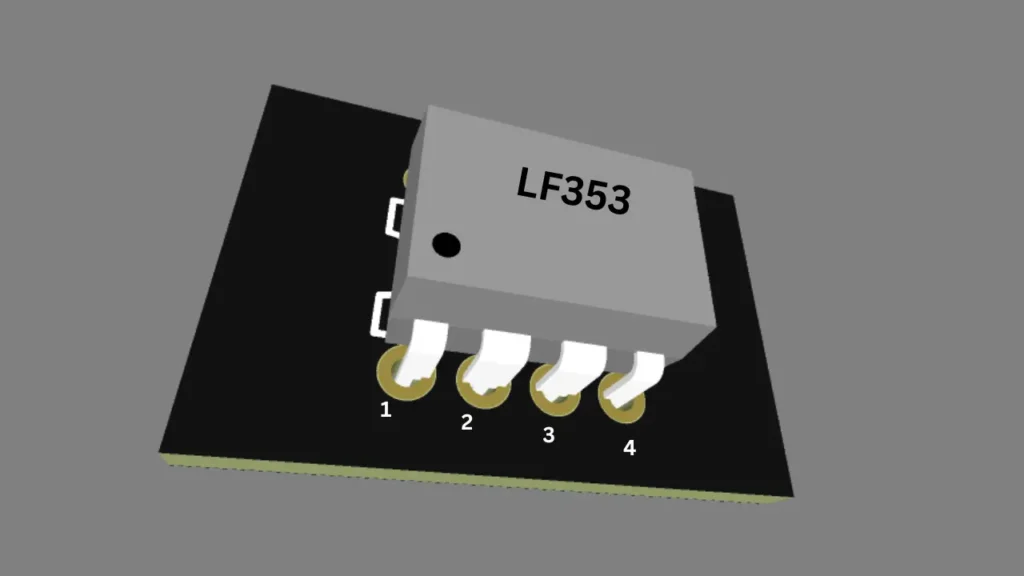
LF353 Pinout
Hold the 8 pin IC in normal position as pins are facing down to earth and the Ic the notch (small marking on the IC) must be in the up side position then count the pins starting from the left as 1 to 4 in one side and the other side starts from the bottom right side pin 5 to 8.
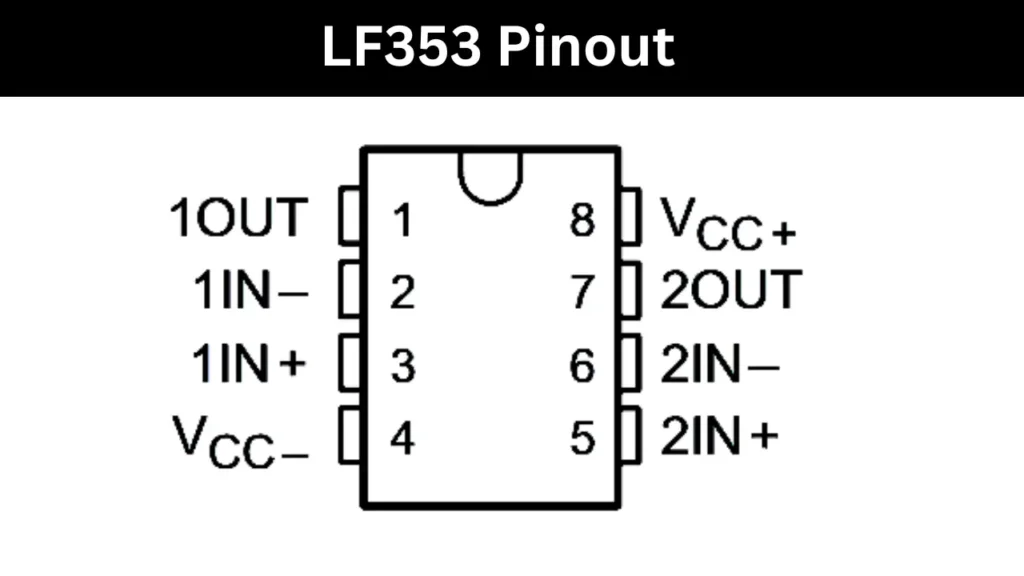
Pin Configuration and Description
| Pin Number | Pin Name | Type | Description |
|---|---|---|---|
| 1 | 1OUT | Output | Output of Op-Amp 1 |
| 2 | 1IN– | Input | Inverting Input of Op-Amp 1 |
| 3 | 1IN+ | Input | Non-Inverting Input of Op-Amp 1 |
| 4 | VCC– | Power Supply | Negative Power Supply |
| 5 | 2IN+ | Input | Non-Inverting Input of Op-Amp 2 |
| 6 | 2IN– | Input | Inverting Input of Op-Amp 2 |
| 7 | 2OUT | Output | Output of Op-Amp 2 |
| 8 | VCC+ | Power Supply | Positive Power Supply |
Equivalent Op-Amps
TL072 is used dual JFET-input op-amp with similar characteristics to the LF353 Ic. It offers a low noise, high slew rate and high input impedance. So this IC is Ideal for audio and precision analog applications.
TL082, This is another dual JFET-input op-amp like TL072, but it has slightly higher input noise. It’s a cost effective alternative where ultra-low noise is not critical.
LM1558 is a dual BJT-input op-amp with good general purpose performance. Although it has lower input impedance than JFET types. so it’s suitable for many analog applications.
MC1458 is a general purpose dual op-amp with bipolar inputs. It’s a basic, older design with lower performance but can be used in simple, non-critical analog circuits.
CA3240 is a dual op-amp that uses MOSFET inputs for high input impedance and low input current. It can be used where power efficiency is needed, though pin compatibility must be verified.
LF412 is a higher-precision JFET-input dual op-amp and it offering a better offset voltage and lower drift than the LF353. It is suitable for precision analog signal processing.
Key Difference of LF353 vs 4558
| Feature | LF353 | 4558 |
|---|---|---|
| Input Type | JFET | BJT |
| Input Impedance | Very High (~10¹² Ω) | Moderate (~2 MΩ) |
| Input Bias Current | Very Low (~50 pA) | Higher (~200 nA) |
| Slew Rate | 13 V/µs (fast) | 1.7 V/µs (slow) |
| Gain Bandwidth | 3 MHz | 3 MHz |
| Noise Level | Lower | Higher |
- The LF353 has JFET inputs in it, which will give it very high impedance and low noise in working so it is better for sensitive analog signals.
- The 4558 IC uses BJT inputs, which means it has higher bias current and lower impedance. But the performs is well in standard audio applications.
- The LF353 is faster with a much higher slew rate of 13 V/µs. Which is great for high-speed or clean audio.
- IC 4558 is slower, but still very common in budget audio gear and mixers.