Impedance matching is not just a concept. We can see it in everyday devices and systems, like headphones and mobile devices. A headphone has an impedance of 16, 32 or 64 ohms. The phone’s audio output is designed with the same impedance to prevent distortion and power loss.
What is Impedance Matching?
The impedance matching is defined as the matching of both input and output impedance of a load. When the both impedance are matching it will gives a maximum power transfer from source to the load with minimum signal loss.
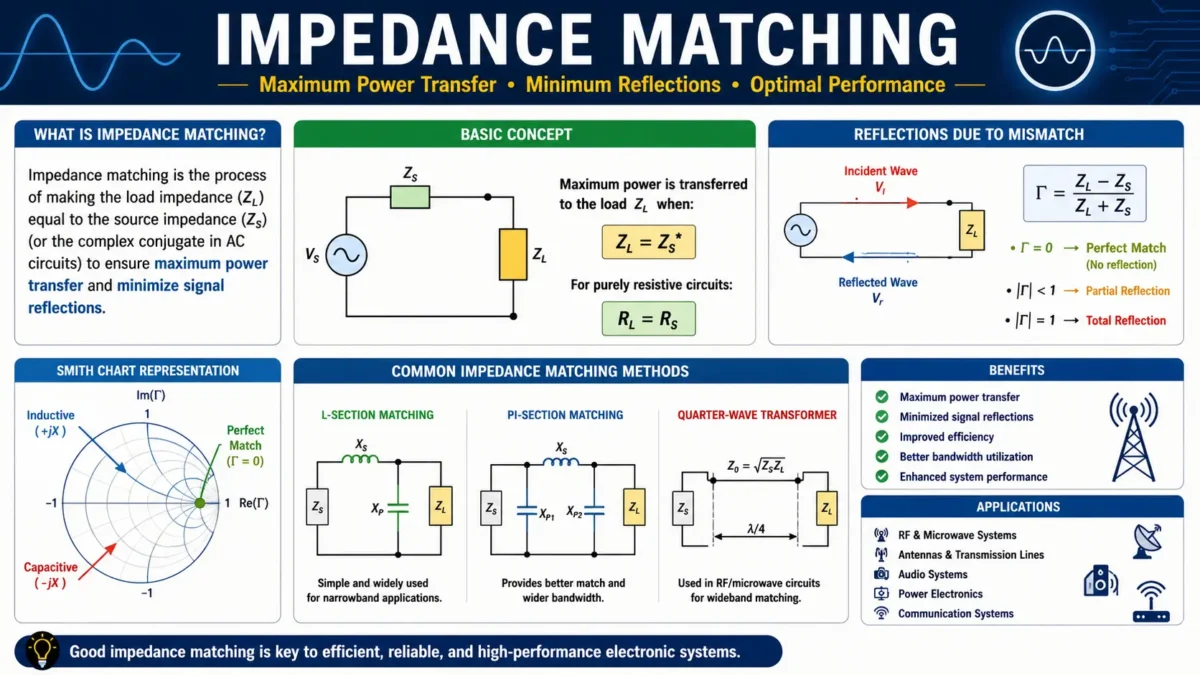
We can simply understand that the impedance matching helps the electronic circuits or RF circuits to communicate efficiently without energy waste.
Why Same Impedance is Important
Impedance matching is a important in electronics and RF circuits because of mismatched impedance will causing power loss, signal reflection and distortion. This problem is more critical in high frequency circuits of RF circuits, audio amplifier circuit and other communication devices.
Proper Matching of Impedance improves
- Power transfer efficiency.
- Signal quality.
- System stability.
- Noise reduction.
- Impedance Matching Principle (Maximum Power Transfer Theorem).
The maximum power is delivered to the load then the Load impedance (ZL)is equal to the source impedance (ZS)
For AC circuits the equation will be,
ZL = ZS*
where ZS* is the complex conjugate of source impedance.
This principle is widely used in communication and amplifier design.
Methods of Impedance Matching
✔ Using Resistors
Using resistors to match impedance is very easiest and simplest method. This method is very common in low frequency circuits and audio circuits, but it is wasting small amount of power as heat energy.
✔ Using Transformers
Transformers are widely used for impedance matching in RF and audio systems. They efficiently match the impedances without the power loss.
✔ Using LC Networks
Inductors and capacitors circuit form matching networks like, L network, Pi-network (π) and T network. This will effectively lowering the power loss.
Matching Impedance in Antennas
In RF equipment’s or device need proper antenna with matching impedance. Standard value of 50 ohms Antennas is used for RF devices to reduce the signal loss. Poor antenna impedance matching cause high VSWR, so it will reduce the transmission range.
Audio amplifier Speaker and circuit Impedance
In audio amplifiers, The matching of impedance in speaker coil and amplifier output prevents the overloading and distortion issues. For example, an 8 ohm speaker should be connected to an 8 ohm output amplifier for best performance. If you are connecting 4 ohms will lead to heating issue of amplifier or speaker damage will occurs.
Advantages Of Matched Impedance
- Maximum power transfer.
- Reduced signal reflection.
- Better efficiency.
- Improved signal integrity.
- Longer equipment life.
Conclusion
Same impedance is essential in electronics for better communication using RF devices and proper performance of audio amplifiers. Mismatched impedance will kill your device and reduce its life along with poor signal with distortion.